Saturday, April 30, 2005

Movie Review: The Hitchhiker's Guide to the Galaxy


Life, the universe and everything. Posted by Hello

So before we even start, let's just throw out there that the answer is 42. Always has been, always will be. But that's not the big mystery of Hitchhiker's Guide - the mystery is what is the question? How do you correctly phrase the question of life, the universe and everything?

And so we commence the voyage of The Hitchhiker's Guide to the Galaxy, a favorite of my sister Ashley and mine since early childhood. Back when we were just little girls, we would look forward to Saturday mornings - not for Scooby Doo or Smurfs, but to watch Hitchhiker's Guide and Dr. Who on the local PBS channel. This strange choice of programming for two young girls may explain some things - once we stayed up all night together, hanging out on our window seat and waiting for Luke Skywalker and Hans Solo to come walking up our cul-de-sac, and why we thought this might happen I still do not know. In any case, we greeted the feature-length, modern-day version of Hitchhiker's Guide with great enthusiasm. In fact, I was so enthusiastic that I braved yesterday's snowy weather to go to the movie theatre at 1 p.m. and secure us tickets for the 7:30 p.m. show.

Ashley handled her enthusiasm by securing mini-bottles of Jamison’s to sneak into her Coke during the movie, and I have to say, she did seem a little more unbridled than usual, perhaps to the disgruntlement of those around us. But we both agreed that the movie does a perfect job of staying true to Douglas Adams' wonderful original (Adams' books are so original and hiliarious that he practically defines the term original), while deftly using today's technology (and the Muppets) to update it.

Brit Arthur Dent (The Office's Martin Freeman) is having a very bad day. Bulldozers have arrived to tear down his house to make room for a bypass. Dent is busy blocking the dozers with his pajamaed self, when his best friend, Ford Prefect (played by Mos Def), shows up with a grocery cart full of beer to stall the workers. He then whisks Dent off to a nearby pub where he buys each of them three pints each, and explains that the world is going to end in 12 minutes. Dent isn't really grasping this, but when the world-ending Vorgons show up in huge intergalactic space ships and announce that Earth will be blown up to, ironically, make room for an intergalactic bypass, people are starting to catch on. Dent doesn't notice, so preoccupied is he about his house, but the people in the bar ask if they should lay down on the floor and put paper bags over their head. "Sure, if you want," Ford says. As the world comes to its promised end, there are the barflies, lying on the floor, paper bags on heads, for really no apparent reason other than that’s apparently what people in mass suicide cults seem to do. So runs Adams' humor.

Ford grabs himself and Dent a ride on the Vorgon spaceship, and then explains that he's not really from Earth, but in fact a writer for the galaxy's best-selling book: The Hitchhiker's Guide to the Galaxy, which contains the answers to everything, even though most of those answers are quite useless. (For example, when Ford asks the Guide how to save someone from the Vorgons, it says "don't bother." And so forth.)

That begins a long space journey for Dent, throughout all of which he remains in his slouchy pajamas and terrycloth robe, while Ford stays clean as a whistle in a white suit. They soon hook up with the President of the Galaxy, Zaphod Beeblebrox, played whimsically by Sam Rockwell who takes the opportunity to cleverly mock current President of the Galaxy George W. Bush, as well as Dent's would-be girlfriend, Trillian, who was whisked away from him back in England when Zaphod decided to drop in on Earth and crash a London party.

("What did he have that I don't have? Two heads?" Dent asks Trillian. "A spaceship," she responds.)

The coolest part of the movie is when Dent and his guide for the moment, Slartibartfast, tour the mythical Planet Magrathea where planets are constructed. I don't know how they did this scene back in the late 70s and early 80s when the BBC made The Guide into a TV series, but with modern movie-making techniques, this scene was amazing. Dent and Slarti zip past planets under construction, mounted in a massive intergalactic sound stage, and when they reach Earth, workers are spraying water to make oceans, painting canyons red and landscaping houses.

The performances don’t really stand out, which is I why I didn't rate the movie higher. The actors do a fine job, but it's just way too hard to make something new of characters that rabid Guide fans already know far too well. To get too crazy would disappoint too many people, and that limits the actors' choices.

John Malkovitch shows up randomly as a spider-like preacher-man, essentially playing himself as always, and Alan Rickman mellifluously voices Marvin, the depressed robot.

Freeman as Dent and Def as Ford are perfectly cast. Zooey Deschanel as Trillian gets the most leeway, because if Ashley and I remember correctly, Trillian was a dopey blonde in the BBC original.

The thing that will always be best about The Guide is Douglas Adams' original concepts and his random humor, and this movie is successful because it remains so true to them. That's largely because Adams collaborated with Executive Producer Robbie Stamp until Adams' early death of a heart attack in 2001, so the film doesn't veer too far away from his vision. Spike Jonz (Being John Malkovitch, which may explain the actor’s appearance) was asked to direct this film, but he declined, recommending two English music-video directors instead. The pair of Hammer and Tongs, otherwise known as Garth Jennings and Nick Goldsmith, took the movie over and did an admirable job in their first feature film venture.

I wanted to use martini glasses as my star system, but this blog doesn't support symbols so I'm giving The Guide three and a half asteriks (what it does support) out of a potential five. I think Ashley would give it a full five. I asked her to write her own review and she said: "Brilliant!" and tottered off to make drunk phone calls. So that may be it from her.

The Hitchhiker's Guide to the Galaxy: ***1/2. A lot of fun.

Springtime in Boulder

Occasionally means blizzard. Bummer for me, who would be happy in 115 degrees in Miami, but great for all the skiiers. The ski lifts may never close!

Boulder today:


Winter returns -- April 29 Posted by Hello

Boulder just a few days ago:


Spring hiking on April 23Posted by Hello


tulips on the mall Posted by Hello


Boulder Theatre -- the best place in town to catch a movie or a band Posted by Hello

Thursday, April 28, 2005

Book review: Garlic and Sapphires

When I was a little girl, reading was my favorite thing. I would while away hours at a time, my nose deep in a book, my brain somewhere else completely. To me, reading was better than TV, better even than the movies.

These days, older, not much wiser and much more distracted, I often long for nothing but an airplane or a beach so I can devour a book cover to cover, so quickly that it's a miracle I remember it at all. But there's very few books that convince me to surrender my whole weekend to it and a comfy chair.

Ruth Reichl's three memoirs - Tender at the Bone, Comfort Me with Apples and now Garlic and Sapphires - are those sorts of books for me. Reichl writes real life so that it feels like fiction, and her lush but simple prose about food makes me want to do nothing but eat.

Here's her description of water: "I tipped the liquid into my mouth and it was instantly flooded with icy coldness and a deep, ancient flavor, as if the water had come bubbling up from the middle of the earth." Some have said Reichl can be a little overzealous, and maybe that's true, but don't you long for a deep, cold drink of water right now? And I don't even like water.

In Garlic and Sapphires, one of the first restaurants Reichl reviews in her new post as the restaurant critic for the New York Times is Honmura An, a now-famous Japanese noodle house in Manhattan. About the restaurant's soba noodles, Reichl writes: "The noodles are earthy and elastic, soft and slightly firm to the tooth, and when you dip them into the briny bowl of dashi it is as if land and sea were coming, briefly, together."

After reading that, I have had an insatiable yen for noodles, a dish I love, but repeated visits to Noodles & Co., a Boulder chain restaurant, have not cured me. Mainly because everything I've had there that actually involves noodles sucks, frankly, although the non-noodled mixed grill is good.

Reichl's clear adoration of food explains why she went from obscure food critic at a small San Francisco weekly to the restaurant critic at the Los Angeles Times to the country's most powerful dining critic. The Grey Lady's snobby climate got to even Reichl, and she moved on to head Gourmet Magazine in April 1999, making it into a gorgeous monthly homage to food, wine, culture and the written word.

Like J.K. Rowling, another writer whose work I've inhaled, I can't quite put my finger on what makes Reichl's writing so compelling to me. Both women use simple sentences that convey exact but full meanings. You know Rowling delivers a precise image when you see the Harry Potter movies - every character from Harry to Hermione to Professor Dumbledore looks just as you imagined them. Reichl's books haven't been made into movies, but her goal is different. While Rowling is precisely describing characters and situations, Reichl's talent primarily is describing eating experiences. Having said that, she also creates memorable characters, and one wonders how much of them are real and how much of them are fiction. I'm always left wondering if the people she writes about end up insulted, dead, or so insulted that they died as a result.

Reichl's other books deal with her childhood and her eccentric parents, and then move on to cover her life in Berkeley cooking organic food in a commune in the 70s. Always she winds the food into stories, including her favorite (and always simple) recipes as part of the text.

The title of this book comes from Four Quartets by T. S. Eliot. Reichl's husband, TV news producer Michael Singer, cites it to her after a particularly horrible dinner with an unbearable food snob who won dinner with her at a charity auction. After Reichl behaves boorishly, lording her vast food experiences and knowledge over the self-described "food warrior," Michael walks out of the dinner at Windows on the World, feigning having had oral surgery that morning. Upon arriving home, Reichl questions her husband's abrupt departure. He quotes: "'Garlics and sapphires in the mud ...' I remember that when you got into this it was almost a spiritual thing with you. You love to eat, you love to write, you love the generosity of cooks and what happens around the table when a great meal is served. Nothing that went on last night had anything to do with that. ... There must be better ways to give," he says. "Don't give yourself away."

When I was Broadcasting & Cable's Los Angeles Bureau Chief, I thought a lot about how people treated me a certain way because of what I could or could not (or would or would not) do for them. Now that I am not in that position, those relationships have changed, as I expected they would. Reichl allowed herself to get caught up in the power of the country's most powerful paper, as anyone would. When she finally realized the pressure and the false power was turning her into a person she didn't like, she knew it was time to move on.

Reichl has lived a rich life, and done us a favor by capturing it on paper. But what annoys me is that she spends her whole life eating and remains slim. She told Salon.com in 1996: "I think I have a very good metabolism. I haven't gained or lost weight for years. I think it's partly that I'm not obsessed with it. I eat what I want. I probably eat a lot more when I'm cooking for myself, because I'm making exactly what I want made to my taste."

If I were a restaurant critic, I would certainly weigh 400 pounds. Definitely proof that life is not fair, or that some people are better suited to restaurant criticism than others. (Garlic and Sapphires by Ruth Reichl, 328 pages, The Penguin Press, $24.95)

Monday, April 25, 2005

Making money on Rob and Amber

Here's a link to my latest story in the New York Post's TV Week: Why We Hate Rob and Amber.

It's a coincidence that I ended up writing about reality TV's hottest (and now married) couple, when I recently blogged on the same idea. But the TV Week editor happened to call me up and ask me to take on that topic, so I happily agreed.

But I have to admit that I'm back to rooting for them. Even though they were bastards for driving past the Jeep, well, it is just a game ...

Friday, April 22, 2005

Bush and the media

Right-wingers think the liberal media have dictated the press for far too long, and they hate Clinton for the questionable choices he made in his personal life. I think, however, that the way the Bush regime is working to control the media (and then acting like the media have no relevance to them) is far more disturbing. This administration is completely ignoring the First Amendment; in fact, they are constantly working to undermine it. To me, the ability to know what is actually happening within the government my tax dollars support affects the quality of my life far more than knowing who is doing Clinton in the Oval Office. Eric Alterman's excellent piece at The Nation.com explains all this. Go there to learn a little something.

Friday, April 08, 2005

Schiavo memo surprise? Not so much

Are all these newsies breathlessly reporting the "discovery" of a memo describing how Capitol Hill Republicans planned to use the Terri Schiavo case for political gain actually surprised? Are these people really this naive? Where's that hard-boiled cynicism these reporters are supposed to have developed by now? Wasn't advancing the Republican agenda the point of the whole endless thing, from which we were only saved by the death of the pope, which is also dragging on interminably? (Do I really need to see his 84-year-old corpse 65 times a day? People who really want to see that are camping out at the Vatican -- so we can assume the rest of us are okay with missing it. In fact, maybe some news organization should set up a temporary digital news channel to cover the pope and his funeral and so on so the 10 billion of us in the world who are not Catholic and don't care one freakin' whit can get on with our lives.) Anyway, didn't right-wingers keep Terri Schiavo on the front-burner so they could keep framing the debate on right-to-life issues in their favor? That's what I thought anyway.

So my reaction to this news that a staffer for Sen. Mel Martinez (R-Fla.) authored a memo that called the Schiavo case a "great political issue ... and a tough issue for Democrats" is ... who the hell cares? The poor guy, senior legal staffer Brian Darling, has since resigned, a pariah to the Republican cause. Um, hello, there's no way Sen. Martinez and his Republican counterparts weren't having this conversation. Maybe they didn't want it published by ABC News, The Washington Post and the Associated Press (by means of a memo assuredly delivered unto those prestigious news organizations by a lucky Democratic staffer who found a draft in a trash can somewhere and ran as quickly as possible to the phone) but they were certainly discussing all along how to turn Terri Schiavo into a political cause celebre.

That's what this story was all about. Schiavo long ago stopped being a brain-dead individual fighting for her right to lay in a hospital bed forever more and became a political issue, a way for Republicans to draw very bright lines on where they stand on these so-called right-to-life issues. That way of thinking - done best by Karl Rove - won George W. Bush the election. Republicans managed to turn San Francisco Mayor Gavin Newsom's attempt to do something nice for his many gay constituents by letting them get married into a major, divisive, election-day issue. At that moment, the election -- very helpfully for the Rs -- stopped being about the war and the morass it has become and started being about moral values. And when that happened, a little more than half the country (and more than enough) had no choice but to vote their conscience. Their God and their religion demanded nothing less. I can't blame those people for standing up for what they believe - I'm just saying that the Republicans are experts at taking over the debate and using it in their favor. Meanwhile, the Democrats barely play defense to Republicans' Super-Bowl worthy media offense, and their offense never leaves the locker room. That's possibly out of sheer terror, but it's all to the Democrats' great disservice and disempowerment. Air America isn't the answer, by the way, and Jon Stewart can't and doesn't want to solve the Democrats' media disconnect by himself.

Besides using Terri Schiavo as a Republican branding campaign, the Schiavo case also represents another chapter in the Republican Party's long-standing effort to brand liberals as anti-life, or more recently and more brutally, pro-death. That's pretty ironic if you think about it. Somehow the Republicans have managed to make liberals -- people who are typically anti-death-penalty, anti-war and pro-gun- control -- pro-death. But having said all that, liberals want choice for women, and that means death for unborn embryos, so that's pro-death. No big deal that most of those "saved" children will go into the welfare system that Republicans don't support, and later into a public education system that Republicans also don't support. No worries! Without much of an education, these kids will end up signing up for the Army where they can later die in Republican-led wars. Problem solved. In fact, maybe that's the secret reason why right-wingers are anti-choice - maybe they fear that with choice we won't have enough displaced people willing to go abroad and die in Republican-endorsed wars. But anyway, sure, it's those crazy liberals that are pro-death. Actually, I think they are just pro-death with regard to certain Republicans and radio talk show hosts.

When a story like Terri Schiavo or Elian Gonzales or even gay marriage shows up in the news and won't go away, assume anyone that can -- Rs and Ds -- is using it for political gain. That's how the system works. What's more important is who plays that game most successfully -- because that's who holds the power.

And for another, but similar, opinion on this subject, check out Eric Boehlert's piece at Salon.com .

Tuesday, March 29, 2005

Disillusioned

This is a big shift from Terri Schiavo, right-to-life issues and whether or not cable news channels are actually doing a good job, but tonight I was laying around at home like a big blob (I know that's a lovely image. I wasn't totally blobolicious, I did manage to paint my toenails and fingernails, which of course I promptly screwed up). While painting away, I watched CBS' Emmy-winning The Amazing Race, which features Rob and Amber, the now-engaged winners of Survivor: All-Stars.

When I watched Survivor: All-Stars, I was impressed with the Rob and Amber combo. They played the game ruthlessly, but with skill and determination, and I believed they deserved to win even though most of the other competitors told them at the end of the game that they were the worst people they had ever met.

Sore losers, I thought during that last tribal council. And it was so romantic when Rob asked Amber to marry him on live television.

So tonight I'm watching The Amazing Race, rooting for my favorites Rob and Amber, and getting progressively more disgusted by their behavior. An older woman, Gretchen, fell in a cave and seriously cut her head, and all Rob had to say was that her doting husband, Meredith, probably pushed her so they could con everyone out of their money. After that, Meredith and Gretchen came in last. Instead of eliminating them, the show's host seized all their money and belongings, guaranteeing them even rougher going the next day. When the pair took up a collection from the other players the next morning, Rob refused to contribute, saying “it's a game” so he and his fiance weren't going to help.

Later in the race, another team literally rolled their jeep while driving in the African outback. Every other team stopped to make sure the two were okay; Rob and Amber just drove on, not even slowing down.

Competitively, that was the right decision, because it put Rob and Amber in second place at the end of the round when previously they had been losing more challenges than Rob could stand.

Turns out, the older couple managed to come in fifth, even without belongings or money, securing their place in the race. And the brothers who flipped their car came in sixth after a sprint to the finish, beating the endlessly battling couple who still said they planned to stay together even though it's apparent to all of America that they hate each other.

Still, I thought the right thing to do would have been to eliminate Rob and Amber for bad behavior, giving the fighting couple their spot. Not that the fighting couple was so much better - they were the only other team that refused to give Meredith and Gretchen money. But at least they slowed down to see if everyone was all right. At the end of the day, people's lives are more important than any game, even ones played on TV. Especially ones played on TV, because now we all know who Rob and Amber really are. And I was such a fan ...

Saturday, March 26, 2005

Enough Terri Schiavo already

I'm working on a story right now about conservative books, so my research journey has taken me to Fox News Channel and many conservative blogs - see Captain's Quarters, AnnCoulter.com, RichardPoe.com and NewsMax.com. If you are on this site, you have likely read some of my other posts, and you have figured out that I'm not a big fan of the U.S. conservative movement. As Andrew Sullivan points out, it's really more of a move toward fundamentalism and away from libertarianism, which is ironic in light of the fact that the 9/11 attacks, one of the major catalysts for this shift in the party, were perpetuated by fundamentalists, albeit Muslims not Christians.

Anyway, what I'm confronted with in all these right-wing places is Terri Schiavo. No big surprise, but it's opened my eyes a little. Even though I'm a member of the media, I have never understood how some of these micro stories become mammoth monster stories that take over the news agenda of the entire country. Why Terri Schiavo, Elian Gonzalez and Lacy Peterson? Why not the many, many other brain-dead, hospitalized victims; Cuban refugees; or murdered wives?

I still don't know the answer to that question, but what I did learn (or what I was reminded of), is the copycat nature of news in the U.S. Watching Fox News, which last Thursday was airing Terri Schiavo almost to the exclusion of anything else (except a brief dip into the Michael Jackson lawsuit), I remembered exactly why discussion of the case has taken over -- fear. If Fox chooses to cover Terri Schiavo night and day, and Fox is the cable news leader, then everyone else has to cover it night and day because of the fear that viewers will leave in droves, ratings will plummet and everyone at the network will lose their jobs.

It's that point I believe the cable news directors lose their judgement. I do think the Terri Schiavo case is an interesting and important debate on morality and the right to life or lack thereof, and I do think this country should engage that debate. I do not think it should black out the news agenda to the exclusion of most of the rest of the news. What's more, with so many 24/7 news channels available, plus the Internet, and so on and so on, couldn't someone get brave enough to drop coverage of the Schiavo case unless something actually happens? And when it does, couldn't they just report that, maybe analyze it a little, and move on?

To some extent, I think copycat journalism is just easier. Why go break new and interesting stories when you can follow what everyone else is following? Why analyze trends or provide real, useful information when you can just chase your competitor? Why waste time examining what is happening on the international front that none of us really know about?

I also know from experience that most news organizations are limited in their funding. News outfits aren't run as non-profits, unfortunately, and thus are obligated by their corporate parents and their stock holders to show a profit margin. As a result, even if CNN makes lots of money, the channel still is forced to adhere to a strict budget so as to deliver profits to the corporate bottom line.

Within that budget, reporters, editors, and producers all feel obligated to cover the day's news agenda, even if it is repetitive and boring. They don't want to look like they got beat by their competitor. And at the end of the day, all of those news teams have nothing left - energy, resources, inspiration -- with which to bring original stories. They've given what they have to the issue of the day, and so have the reporters from every other news service.

If the news channels could somehow get brave enough to architect their own agendas and stop worrying about what the other guy is doing, that would much better serve the public interest and educate the democracy. The cable news channels could leave the nitty-gritty reporting of these ongoing stories to the wires and the major papers, report them as obligated, and spend their resources on the cutting-edge, the new, the unknown.

It's up to us, the consumers, to let the news organizations know we are fed up with copycat reporting by turning it off and demanding something better. As members of a democracy, we are obligated to educate ourselves on the issues of the day and the decisions--both pending and completed--of our government. To cite my hero, Oprah: what I know for sure is that there's more going on out there than Terri Schiavo.

Wednesday, March 23, 2005

I'm Stuck in Rehab with Pat O'Brien

I hate to be totally evil at someone else's expense ... oh, who I am kidding? I love it! Anyway, the following link will take you to one of the funniest things ever available on the Internet. Unless you live in Boulder and never watch TV and have no idea who Pat O'Brien is, BUT if you know anything about the TV industry at all, you will find this hilarious. So go there now:

I'm Stuck in Rehab with Pat O'Brien

Feel free to return and ask questions in the comments section of this blog.

Thursday, March 17, 2005

Slacking

OK, I have been a horrible, horrible blogger. I didn’t even blog about the Oscars, which I had been leading up to for weeks.

So what brought about this complete lack of responsibility to my blog and the four people who read it? The deadly combination of travel, laziness and illness – so I’ve actually had tons of things to blog on about but no motivation to capture it all on paper or computer screen, as it were.

I feel like the Oscars passed me by, but let me say a few things.

1) I found the ceremony boring – including Chris Rock. And even though I appreciated Executive Producer Gil Cates’ attempts to spice things up a bit by placing all the nominees on stage so that most of them could be rejected and then recorded trying to cover up their disappointment, I found the exercise crueler than even the everyday reality show. This represents people’s life work in many instances – can’t you just let them slouch in their seat when they lose, like they get to do at every other awards show? I hope that format does not become a trend.

2) I like Beyonce as much as the rest of us, but one song with her would have been plenty. Also, what the hey did Antonio Banderas and Carlos Santana do to that song from Motorcycle Diaries? I think that when the guy won he was relieved so he could come up and let everyone know that it was actually a good song before the Banderas/Santana combo got their hands on it.

3) I didn’t pick Million Dollar Baby, but my excuse is that I hadn’t seen it when I made my picks. I’m not sure I would have changed my votes, however. The movie really gained steam toward the end of the voting process, and the acting nods for Hilary Swank and Morgan Freeman really sealed the deal for Clint. Could Clint ever direct a movie that is not miserably depressing? Light-hearted is clearly not in his repetoire, as amazingly talented as the man is.

Meanwhile, I’m still seeing Oscar-nominated movies, even though the moment has passed. Last night, Mom, Ashley and I saw Pedro Almodovar’s Bad Education. In Ashley’s words: “I can’t believe I’m seeing movies about ass-sex with my mother.” And if it disturbed Ashley, you know it was over the top.

Parting comment: Why on earth does CNN insist on covering the blogs with their stupid stupid stupid segment called “Inside the Blogs” during Judy Woodruth’s Inside Politics. Word to CNN: a) computer screens do not make good TV and b) CNN (and all news services) is like the anti-blog, and as such, should not be covering blogs. It drives me crazy on a daily basis (yet I still persist in having CNN on all day because I need something to keep me company and bring me the news, and what are the options?).

And to my four regular readers: Since I have no travel scheduled until the end of July, I plan to be a better blogger in the future.

Thursday, February 03, 2005

Hollywood Reporters, Gatsby Envy and total denial of one's true self

One of the best things about having a blog is that I can just ramble endlessly, with great and fervent opinion, about just about any subject I darn well please. And I can do it without having to directly offend the person I believe has offended me. In fact, I can just passive-aggressively pop off right here on my own site.

Now, if I were a blogger worth my salt, I would have written about the State of the Union address even while it was going on. But since I was drinking wine and chatting with my mother throughout the entire speech, I really have no idea what that guy said except that he told us again he would be pushing for a constitutional amendment against gay marriage and that social security would be bankrupt by 2047 or something like that and that we don't have an exit strategy for Iraq. Wait, didn't we know all that already? I guess I listened a little bit. And I think that hug between the Iraqi woman and the military wife was staged. (Washington's picked up a few tips from Hollywood since Clinton was in office.)

Anyhoo, let's talk about something more interesting to me. (Because it's MY blog and this is all about ME and MY thoughts, right?)

LA Weekly
's Nikki Finke, a talented and gutsy writer, has written the most self-serving response to Bernie Weinraub's revealing NY Times piece (see previous posting) that perhaps I have ever read. Link to it here, read the piece so you know what I am talking about and then come back: LA Weekly: Columns: Deadline Hollywood: Hollywood Reporters and Gatsby Envy

Finke shares with us that even though she's from old money, Hollywood money doesn't affect her. Unlike Weinraub, she is above all that Hollywood glam; she is perfectly happy in her shabby West Hollywood digs. She wouldn't mind driving a rented Chevy among the Jags and Beemers. No, she is in it for the integrity.

Give me a friggin' break. It's one thing to be above it all when you really are poor and have nothing to fall back on. It's another thing to slum when one plane flight back to the East Coast will win you a grant from Mummy and Daddy.

Actually, I don't know that Finke has access to the family money she boasts about, but even the fact that she mentions it renders her whole insufferable article even more ridiculous. Finke uses Weinraub's revelations to further herself. And if that's not vintage Hollywood, I don't know what is.

Wednesday, February 02, 2005

Sex beats crying any day


Imelda Staunton as Vera Drake Posted by Hello


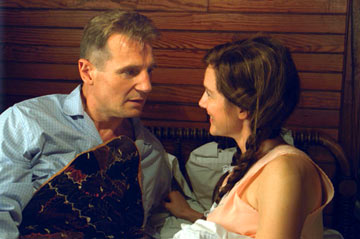
Liam Neeson and Laura Linney as Alfred Kinsey and his wife, Clara McMillen Posted by Hello

One thing about going to see all of the movies nominated for major Oscar categories is that you end up seeing movies that you otherwise would not have seen in a million years. Sometimes you wander upon a wonderful surprise; other times you feel like you are seated before an endless instrument of torture.

While the critics simply adored Vera Drake, I found myself wanting to slit my wrists while watching it. Not because it is so depressing, but because I was so very tired of watching not much happen.

On the other hand, Kinsey was a surprisingly humorous biopic about the most serious of scientist’s deep inquiry into the true nature of human sexuality. I didn’t want it to go on forever, but I thoroughly enjoyed it.

Dutifully working hard to see all nominated films, Mom and I went to see Vera Drake on Sunday. Mike Leigh (Secrets & Lies, Topsy-Turvy, not Lovely and Amazing as I thought) is nominated best director and writer, while Imelda Staunton is nominated best actress.

Not that it’s a bad movie. Of course, it is not. But it is a dreary, interminable, difficult-to-understand-the-dialogue movie. The weather was grey outside anyway, and the movie was grey inside. And while Staunton gives quite a performance as Drake, it mostly involves her crying for about an hour and a half. Well, the first half she’s a perfectly lovely and happy person—mostly going about her life, doing her work, giving cup after cup of tea to the less fortunate and managing to somehow successfully matchmake her terminally shy daughter—but then things change for the much worse.

During a police interrogation, Drake is questioned about her practice of doling out abortion-inducing services for the past 20-plus years, and we are forced to endure what seems like hours of chin-quivering hysteria in which Drake cannot talk or answer any questions. I felt heartless, but I was thinking “after choosing to perform this highly illegal activity for most of her life, wouldn’t this woman be somewhat prepared that the police would eventually catch on?” And frankly, even if she wasn’t prepared, couldn’t we cut past the crying and get to the part where something happens?

OK, maybe I’m heartless. Probably I am. But it is this kind of film that makes me question my movie-going taste. Clearly, Vera Drake is critically acclaimed. But why? It’s a fine movie, but it’s so hard to sit through. At the end, I didn’t feel particularly educated or entertained. I just felt happy the movie was over.

I had a similar experience to this when Tina and I saw Affliction, starring Nick Nolte, way back in 1997. (1997! Seven years ago??!! How on earth is that possible?) We sat in a tiny and freezing theatre in Washington, D.C.’s Dupont Circle and just suffered. Again, it wasn’t a bad movie, I guess, although it sort of seemed bad to me, but it wasn’t an enjoyable movie.

After Vera Drake, I had low expectations for Kinsey, which told the life story of famed sex researcher Dr. Alfred Kinsey, known to his students and loved ones as Prok (short for Prof. K). Oscar-nominated movies are often serious as a heart attack – not a glimmer of comedic light manages to get through. That wasn’t true with this film.

And that’s as it should be. Sex is funny. Not only is the physical act completely ridiculous, from an observer’s point of view, talking about it is also funny. Kinsey does a delightful job portraying the partnership of equals that Dr. Kinsey shares with his wife, Clara McMillen, known as Mac, played by Laura Linney.

Since You Can Count on Me, Linney has become a regular at these awards shows, and her performance in this movie demonstrates why. The performances in Kinsey, particuarly Linney’s and Liam Neeson’s in the title role, are understated and seamless.

In my view, Clint Eastwood took Neeson’s spot among the Best Actor nominees and it’s too bad. Eastwood is a brilliant filmmaker, but his role in Million Dollar Baby is vintage Eastwood – crusty aging guy shows that he has a heart. Neeson as Kinsey gives us nothing we’ve seen before from him. Neeson showed a different side as the noble Rob Roy or The Priest in Gangs of New York; in this movie, he’s an obsessed scientist who goes about collecting his evidence – whether it be wasps or human sex lives – with single-minded passion. He’s not really an exciting man, unless one finds intensity exciting.

Truthfully, maybe I enjoyed Kinsey more than Vera Drake because I was in a better mood when I saw it. Or maybe it was because I could understand every word of Kinsey and I got to laugh a bit. But either way, both experiences are what I love about going to see the nominated films – you never know what you are going to get, but you know you are going to see the best films the year has to offer. For better or for worse.

Sunday, January 30, 2005

The New York Times explains why I left Hollywood

New York Times
January 30, 2005
14 Years Later, My Hollywood Ending
By BERNARD WEINRAUB

LOS ANGELES

I CAME to Hollywood in 1991 thinking I knew quite a lot about the world and its ways. As a young reporter, I had been to Vietnam. Later, I covered Northern Ireland, several political campaigns and the White House under President Ronald Reagan and the elder President George Bush. On arriving, I was fresh from a sudden assignment in India after the assassination of former Prime Minister Rajiv Gandhi. But only in my 14 years here - most of it spent covering the movie industry, the rest covering television and music - did I come face to face with some of the more startling, and not always pleasant, truths about human behavior, my own included.

On retiring (officially, this is my final week at The Times), it seems best to sort through this Hollywood tour. It began in a string of modest, even shabby, apartments - one of them, on Martel Avenue in West Hollywood, best remembered for the cluster of police cars, drug dealers and prostitutes on the corner. Along the way I married a studio chief, Amy Pascal, now chairwoman of Sony Pictures. For both of us, the liaison opened a rare two-way window on the inner workings of two worlds, moviedom and the press, that have long been locked in a messy but symbiotic struggle. But our marriage also changed the game. I won't speak for my wife and her own way of coping with career complications born of an alliance with a reporter, but I can say that our wedding, in August 1997, brought to the fore some of my own shortcomings. Clearly, I stayed too long on my beat, clinging to a notion that I could sidestep conflicts of interest by avoiding direct coverage of Sony, and learning too late why wiser heads counsel against even the appearance of conflict. But my marriage, and some of the events that tumbled out of it, also taught me something about the ferocity of a culture in which the players can be best friends one day and savage you the next.

When I finally asked to be taken off the movie beat in 2000, I laughed and said I felt like the Duke of Windsor. But I quickly caught a lesson in how chilly life as a former movie correspondent could be. In the past, I'd written about Jeffrey Katzenberg, then president of the Walt Disney Company. He returned every call quickly and often phoned me; he dished over pasta at Locanda Veneta about all the studios in town and became such a pal that I once showed him off-the-record comments made about him by Michael Eisner. That was wrong and foolish, and years later I still regret it. As soon as I stopped covering movies, Mr. Katzenberg stopped responding to phone calls. I was surprised but shouldn't have been.

Not every Hollywood moment involved operators like Mr. Katzenberg, nor were they all somehow tied up with my marriage. Fellow journalists contributed their share. In one remarkable episode about two years ago, Robert J. Dowling, the publisher and editor in chief of The Hollywood Reporter, threatened to punch me during a charity event. He was upset by an article I had written about two years earlier dealing with staff resignations after his newspaper failed to print an article about an inquiry by the Screen Actors Guild into whether the Reporter columnist George Christy had received pension and health benefits to which he was not entitled. Mr. Christy's column was soon suspended. (Peter Bart, the editor of Variety and a former Times Hollywood correspondent, went beyond Mr. Dowling: he sought to get me removed from the job because of an article I wrote saying that The Hollywood Reporter was catching up with Variety.)

The Hollywood Reporter scandal was, in fairness, pathetic and hardly on the level of Watergate or Iran-contra. And it wasn't akin to the unfortunate way even more serious journalists are co-opted by the overtures of a Michael Ovitz or the charm of a Joe Roth. Mr. Roth, a top Hollywood player, seems available at any time and is willing to schmooze with eager reporters as if he had all the time in the world.

Mr. Ovitz went a step or two further. Shortly after I arrived in Hollywood and met him, when he was at his zenith as chairman of the Creative Artists Agency, he offered to help if my children needed to attend private school or if I needed to find a hospital. I never took him up on the offers.

MY first day here, as I recall it, was in early September 1991. Having just come back from India, I was struck almost immediately by the prevalence of money, and the crazy economic gap between journalists and the people they covered. It was like dropping into Marie Antoinette's France. In Washington, reporters often lived next door to the people they covered. Whatever the income gap between a reporter and a lawyer or lobbyist - and it's considerable - your lives intersected. In the neighborhood. On the subway. At private schools. At parties.

Journalists in Washington do not feel diminished by their lower salaries. In Hollywood, many do. I did. Waiting for a valet at the Bel-Air Hotel to bring my company-leased Ford, I once stood beside a journalist turned producer who said, "I used to drive a car like that." Though I'm ashamed to say it, I was soon hunting for parking spots near Orso or the Peninsula Hotel to avoid the discomfort of having a valet drive up my leased two-year-old Buick in front of some luncheon companion with a Mercedes.

For many of us on the press side, the money gap leads to resentment and envy, compounded by a conviction that studio executives and producers are no better or smarter than the journalists who cover them. Initially, I was simply amazed. My first real Hollywood acquaintance was Dawn Steel, a producer and onetime studio chief, and one of the more dynamic figures in town. (Ms. Steel died of a malignant brain tumor in 1997 at the age of 51). Before leaving New York, I was in the office of Warren Hoge, then the editor of the Times Magazine, who said Ms. Steel would open the gates of the movie world for me. He called her on her car cellphone, which was still uncommon enough that I was dazzled. She insisted that I see her as soon as I arrived. I did so. Her house off Coldwater Canyon, behind gates and atop a winding road, was a sprawling, ranch-style home with panoramic views of the city on a huge plot of land. I had never seen a home like this.

What made it strange was that Ms. Steel was a girl from Long Island - smart, funny, neurotic. She had no airs. She and so many others in Hollywood seemed like people I knew. I grew up with them. And yet they earned bizarre amounts of money that lifted them into a different universe.

My first reaction was to write about that difference. Early on, for instance, I wrote about movie stars and executives trooping into a specially designed soundstage at Sony for the Hollywood Hunger project to benefit Oxfam America. Instead of simply writing checks, the celebrities sought what the caterer, Ruth Hedges, told me was "the actual experience of being poor and hungry."

So the likes of Danny Glover, Jackson Browne, Daryl Hannah, Whoopi Goldberg, Susan Sarandon, David Byrne and Graham Nash drew lots: 15 percent represented high-income countries and dined at fancy tables on stuffed breast of chicken, sun-dried tomatoes and radicchio, and salad with shrimp; 25 percent represented middle-income countries and sat on benches at wooden tables to eat rice and beans and tortillas off paper plates; and the majority, sat on the floor on a mat and had rice and water, as many people in the world do.

Almost as shocking (at least for me) were the gala events to raise money for ecological causes in the early 1990's. At one such event, 700 of the town's elite (Barbra Streisand, Robert Redford, Ted Danson, Jane Fonda) showed up at a soundstage in Mercedeses, BMW's, stretch limos and other gas guzzlers to celebrate Hollywood's commitment to the environment. The invitations said, "In the spirit of the event, we urge you to car-pool." It didn't appear that anyone did.

Detachment from the real, I soon learned, was closely bound up in the culture of stardom, and star behavior, alas, has a way of rubbing off on those of us who come in contact. At first, as I now hate to admit, I was fascinated by the idea of meeting movie stars. (After meeting a few, the fascination ended.) Maureen Dowd in Washington made me promise I'd interview Michelle Pfeiffer soon after arriving. As it turned out, she was my first star interview. She was promoting the film "Frankie and Johnny," in which, bizarrely, she was playing a frumpy waitress.

I met Ms. Pfeiffer at her office in Century City. I was tongue-tied. She talked about her character's loneliness and how she identified with the waitress. I nodded at whatever Ms. Pfeiffer said. She told me it was a fantasy that beautiful people couldn't look unattractive or weren't lonely or hurt. "It doesn't matter what you look like or how old you are," she said. "That's not relevant." Right. For a moment, I believed it.

At another point, at the Toronto Film Festival, I rushed through an interview with Billy Bob Thornton and Bill Paxton about their film "A Simple Plan." It was important for the two actors to promote their offbeat film and get an article in The Times. I cut short the interview and said, "Look, I've got to interview Cameron Diaz." The pair were dumbfounded. She was prettier and a rising star. She was more important. The fact that I had hurt the actors and embarrassed myself still rankles. Not a high point but perhaps the beginning of real understanding about a world that obsessively chases what's young, what's new, what has heat.

My most embarrassing moment in Hollywood was an interview with Jim Carrey that at least absolved me of star fever. The comedian, in a suite at Ma Maison Sofitel, was promoting his film "The Mask." I had taken medicine for a bad cold. The interview began. I was settled into an easy chair, facing Mr. Carrey with my feet crossed in front of me. As he began answering questions, I fell asleep. The next thing I knew, I was feeling somebody kick the bottom of my shoe with his foot. I woke up, mortified. Years later, I met his manager Jimmy Miller. I told Mr. Miller I had a confession: that I fell asleep while interviewing Mr. Carrey. Mr. Miller exclaimed: "So you're the guy! He talks all the time about a reporter who once fell asleep on him."

IN 1996, I met Amy Pascal for a business breakfast at the Peninsula Hotel. She had just been named president of Turner Pictures, a new company founded by Ted Turner.

Not even 18 months later, the company was folded into Time Warner.

As we began dating, I rationalized that I could avoid any hint of a conflict of interest by avoiding any coverage of Turner Pictures. By the time we were married, the next year, my wife had been appointed chairman of Columbia Pictures. I should have left the movie beat right then, if not sooner.

But with the agreement of my editors, who were confident I could deal with the issue, I felt I could continue covering the movie business, avoiding coverage of Columbia and its parent company, Sony, and leaving that to a colleague. It was a delicate balancing act that seemed to work for a while. But I underestimated how closely I would be watched, or how quickly Hollywood would jump on my marriage as way to get an edge in coverage by The New York Times.

Warner Brothers, once a high-flying studio, was at that time beset by a string of expensive movie flops and its parent company's music operation had a weak track record. With a colleague, Geraldine Fabrikant, I covered the failures at Warner, whose co-chairmen were Robert A. Daly and Terry S. Semel. The two eventually resigned.

Mr. Daly was furious and told friends and others that I should not write such articles because of my marriage, a view I came to share, though I remain convinced that the coverage was accurate and fair. Soon enough, an article appeared in Brill's Content, a magazine covering the news media, by Lorne Manly (now a reporter for The Times). It said that "two Hollywood sources" said Warner had offered my wife a production deal instead of "the high-ranking job she sought," and that "instead she headed to Sony." As I read it, the implication was that The Times's articles were written because I was personally peeved at Warner and not because the studio was experiencing failures like "The Postman" and "Sphere."

I wrote to Bill Kovach, the ombudsman for Brill's Content and a former Times Washington bureau chief for whom I had once worked, to complain about what I called the cheap and inept journalism at his magazine, which was itself financed by Barry Diller, George Soros and others. Would the magazine ever write about Mr. Diller or Mr. Soros? I asked in an angry note. Mr. Kovach responded with equal anger. In retrospect, the nastiness of journalists toward The New York Times - and me - should have been a warning that this was a losing battle.

Mr. Ovitz, who began complaining to The Times about my coverage shortly after I arrived, was soon trying to use my marriage as a lever to oust me. He visited The Times after I had written about his troubled management company, which he formed after his dismissal from the Walt Disney Company. At the time Mr. Ovitz was also facing problems because of a failed Broadway investment and a vain effort to start a football franchise.

"What does The New York Times have against me? Mr. Ovitz asked Joseph Lelyveld, then the executive editor, according to New York magazine. "Your football writer hates me, your theater writer hates me and Bernie Weinraub just killed me."

Mr. Lelyveld said: "What are you talking about? If I got all three writers in a room they wouldn't even know each other."

True.

In a later phone conversation, Mr. Ovitz urged The Times to dismiss me and finally shrieked at Mr. Lelyveld: "You don't know anything about our business! I can't talk to you!"

In mid-1999, Mr. Lelyveld came to Los Angeles. I began our lunch by saying that I wanted off the movie beat. Not because I was tired of it, but because it was being used as an excuse to attack me and the newspaper I loved. Mr. Lelyveld was visibly relieved. I had saved him from saying it was getting difficult for the newspaper. I asked about covering television and other entertainment. He agreed.

IN December 2001, less than three years later, I received a call from Julia Phillips, the once-hot producer of films like "Taxi Driver" and "Close Encounters of the Third Kind," who had drifted from center stage in Hollywood long before she wrote her classic tell-all, "You'll Never Eat Lunch in This Town Again." To my regret, I asked her to hold on one minute while I finished on another line. As soon as I returned, Ms. Phillips said: "I'm dying. And I want an obituary in The New York Times."

Shortly after arriving in Hollywood, I had met Ms. Phillips late one chilly afternoon at the Polo Lounge at the Beverly Hills Hotel. I wanted to write about her as the author of a slash-and-burn chronicle that detailed the selfishness, duplicity, nastiness and greed of the Hollywood stars and executives she knew in the 1970's and 1980's. The book also revealed her own plunge into cocaine addiction.

Ms. Phillips said she was a pariah in town. "I saw these people for what they were," she said. In the years that followed I became friendly with her: she would call me periodically to either congratulate me on an article or criticize me, saying I was naïve or had been duped. At dinner at Orso, her favorite restaurant, she was brutally honest about herself and about the Hollywood crowd. "Don't trust these people," she warned me numerous times. "Don't trust anyone here."

I laughed and didn't really believe her. But with time I came to realize that she, more than Dawn Steel, had become my most reliable guide to the ways of what insiders still like to call "the town."

Responding to her call, I immediately drove to see her in her apartment looking out onto West Hollywood and, on a clear day, downtown. I said I wanted to tape-record some interviews for an obituary. And I asked if she wanted anything else. Ms. Phillips said she adored George Clooney and would love to see his latest film, "Ocean's Eleven." (Warner Brothers, which had tapes of the film, sent her a copy the next day.) I spent several days visiting and interviewing her.

Because of her book, Ms. Phillips was an outcast among Hollywood's elite. "At first it bothered me because I really didn't expect that kind of reaction," she said. "I thought people had a sense of humor. I really did.

"Understand, I wasn't a pariah because I was a drug-addicted, alcoholic, rotten person and not a good mother," she said. "I was a pariah because I lit them with a harsh fluorescent light and rendered them as contemptible as they really are."

Ms. Phillips died of cancer in the early days of 2002. I went to her funeral service on the rooftop of her apartment building and thought of what she said while dying. Was it an overstatement? I wonder. I'm part of the Hollywood world now. I can't deny it. I drive a Range Rover. I live in Brentwood. Not everyone is contemptible. Perhaps Julia Phillips was wrong. I hope she is.

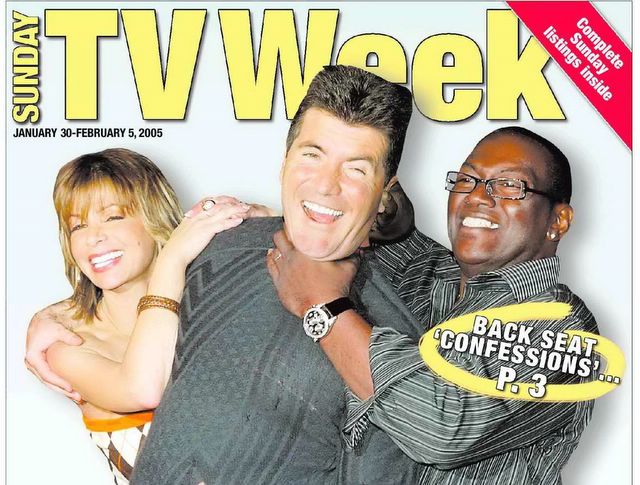
If you can't brag on your own blog, then where can you?


Is Simon's head superimposed in this picture? It looks too big to be real. Or not. Posted by Hello

Here's a link to the NY Post's TV Week, where I sold a story this week. My story, with my byline and everything, is right on the cover!

A friend in LA said to me: "isn't the rule that if you get three stories in the New York Post, you get to write for the New Yorker?" I said "no, I think the rule is that if you get one story in the New York Post, you are forever forbidden from writing for The New Yorker."

So don't look for me there.

Friday, January 28, 2005

Buster's friend has two mommies


Buster visits Wind River, Wyoming Posted by Hello


Buster goes rock-climbing in Boulder Posted by Hello

In case you were wondering whether the Bush Administration actually is an evil cabal of would-be dictators who are pretty sure that they know how everyone else should live, the following article should clear that up.

Written by the hilarious Lisa de Moraes, TV columnist for the Washington Post, the article discusses how PBS, in its all-too-familiar role as eternal political punching bag, caved completely to the Education Department (aka Bush Administration’s czar in charge of how schools should be run even most of the government’s money is going to Iraq).

DOE recently became aware that in one episode of PBS’ Postcards from Buster, the animated bunny visited real-life families in Vermont and learned, shock of all shocks, that two of his new friends had two mommies. The episode wasn’t really about that—it was about how to make maple syrup and cheese and how to speak English—but the two mommies were present and visible. In response to pressure from the Administration (a constant refrain of ‘if you don’t behave yourselves and portray the country in the way we want you to we will pull your funding’), PBS disintegrated like a wet cardboard box and decided not to distribute the episode.

This is not new behavior from PBS. And I have to say I don’t blame them, even though I do think they are pretty much a bunch of lily-livered cowards (what exactly is a ‘lily liver’? Does anyone out there know? And does lily have one L or two?).

The service gets only about 10% of its funding from the government – aka taxpayers. That’s not so much, but it gets the remainder of its money from corporate sponsorships and public fundraising. Constantly accused of having a strong liberal bent, PBS proves Republicans correct when it pulls stunts such as admitting that there are gay people in America. It also faces constant criticism from TV writers and other media watchers who gripe any time anything like a commercial shows up on PBS’ air. That means that if a voice-over comes on after a show saying “this presentation of Nova sponsored by Juicy Juice,” someone has a problem with it.

So, with Republicans looking for any opportunity to kowtow to conservative constituents and liberals watching closely for creeping commercialism, that doesn’t leave PBS with many places left to go to get its money. They end up having to kowtow to someone just so they can keep funding themselves.

According to what I infer from DOE’s objections to the Buster episode, this type of information could be damaging to pre-schoolers’ fragile brains. According to what I infer from preschoolers that I know, they could care less. Preschoolers don’t know that two women or two men or a black man and a white woman or an alcoholic and an enabler aren’t supposed to meet and mate. They just see kids and parents, fun or no fun, love or no love. It’s when the adults, with their closed minds and absolute certainty that things are supposed to be a certain way, get involved that things get complicated.

Of course, I am bringing my own closed mind to this debate, as I am demonstrating by writing this. My closed mind believes that it’s no one else’s business if two women or two men want to have babies. If you are opposed to that or if that disgusts you, that’s your business. What I don’t understand is why people feel so obligated to impose themselves and their way of thinking on others.

With regard to TV programs and kids, I always make two points: 1) there’s an off button and 2) there’s a First Amendment. That means that in this free country of ours most material—other than that which can be proven patently offensive, and that’s not much—should be free to be consumed. It also means that if you have chosen to be a parent, that requires parenting. And parenting requires monitoring a child’s TV watching.

For every parent that’s opposed to kids knowing that some people are gay, there are other parents who are all for it. Why should the pro-gay constituency be penalized by the anti-gay one? Why can’t the anti-gay constituency just change the channel? That's what we liberals do when we accidentally come upon Fox News.

Now, granted, it’s a lot to ask for parents to know the content of every PBS program and episode before their child sits down to watch it. And parents need to have channels where they feel safe letting their children hang out.

But it seems to me that this could be quickly handled by distributing episode information for TV guides ahead of time, and also issuing a warning statement prior to and maybe inside of the program. Even that seems a little Draconian to me, but in fairness, I don’t think parents should be ambushed by potentially objectionable content.

While I think that all the hullaballoo about Janet Jackson’s stupid breast is the most overwraught, pointless, useless debate practically in American history, I also think that Janet and Justin and whatever producers knew about the stunt ahead of time (and whatever they say, at least the two performers knew good and well what they planned to do), and that their 'impromptu' performance took away millions and millions of parents’ right to choose what their children see. That’s where the huge mistake was made. I wonder if Janet and Justin would make the decision again if they knew ahead of time that exposing her breast would threaten our freedom. And I don't think I'm being overly dramatic when I say that, given the debate and censorship that has taken place in this post-Janet world.

I believe people should be given information that allows them to make a choice. What I definitely don’t believe, and the constitution backs me up on this, is that material should be censored just because the party in power objects to it.

PBS's 'Buster' Gets An Education
By Lisa de Moraes

Washington Post
Thursday, January 27, 2005; Page C01

PBS was surprised to receive a letter from new Education Secretary Margaret Spellings, warning the public TV network against airing an upcoming episode of the kids show "Postcards From Buster," because PBS had already informed her office it would not send the episode to its stations, programming co-chief John Wilson says.

"We made the decision . . . [Tuesday] afternoon, a couple of hours before we received the letter from the secretary of education," Wilson told The TV Column yesterday.

"It came at the end of many days, maybe even a few weeks, of looking at rough cuts of the program and deliberating."

Spellings, who has been charged with the difficult task of fixing the nation's troubled public education system, took time out on her second day on the job to fire off a letter to PBS CEO Pat Mitchell expressing "strong and very serious concerns" about the "Postcards From Buster" episode. Specifically that, in the episode, called "Sugartime!," the animated asthmatic little bunny visits Vermont and meets actual, real-live, not make-believe children there who have gay parents.

For those of you unfamiliar with the spinoff of the popular children's series "Arthur," which combines animation and live action, each week, 8-year-old animated Buster and his animated dad travel to another locale, where Buster, armed with his video camera, meets actual, non-animated people, who introduce him to the local scene -- clogging in Whitesburg, Ky.; rodeo barrel racing in Houston; monoskiing in Park City, Utah; doing the Arapaho Grass Dance at the Wind River Reservation in Wyoming. Additionally, Buster meets a family from a different cultural background.

In the episode that knotted Spellings's knickers, Buster goes to Vermont and meets children from two families, who show him how maple syrup and cheese are made.

At one of the homes, Buster is introduced to all of the children and to the two moms. One girl explains that one of the women is her "stepmom," whom she says she loves a lot.

One of the women asks the kids to get some maple syrup and some cheese for dinner, and to stop by the other home to borrow a big lasagna pan. In the other home, Buster is introduced to the whole family, including two more moms. Then the kids head off to get the ingredients, and Buster learns where syrup and cheese come from.

In her letter, Spellings reminded Mitchell that the show is being funded in part by the Education Department and that a principal focus of the law authorizing such "Ready-to-Learn" programming is "facilitating student academic achievement."

In the conference committee report for fiscal year 2005 appropriations, Spellings continues, Congress reiterated that the unique mission of Ready-to-Learn is: "to use the television medium to help prepare preschool age children for school. The television programs that must fulfill this mission are to be specifically designed for this purpose, with the highest attention to production quality and validity of research-based educational objectives, content and materials."

"You should also know," Spellings says, "that two years ago the Senate Appropriations Committee raised questions about the accountability of funds appropriated for Ready-To-Learn programs." A bit ominous, we think.

"We believe the 'Sugartime!' episode does not come within these purposes or within the intent of Congress and would undermine the overall objective of the Ready-To-Learn program -- to produce programming that reaches as many children and families as possible," Spellings wrote.
Why, you might wonder, given that preschoolers who watch the episode learn how maple syrup and cheese are made, not to mention useful English-language phrases (the series is also designed to help children for whom English is a second language).

Because, Spellings explained in her letter, "many parents would not want their young children exposed to the life-styles portrayed in this episode." She did not say how many is "many," or cite a source for that information.

Congress's point in funding this programming "certainly was not to introduce this kind of subject matter to children," she added.

Au contraire, says WGBH, which produces "Postcards." The Boston public TV station says it will air the episode and has offered it to any station willing to defy the Education Department, which, in fairness, did shovel out major bucks for this series and, therefore, understandably feels it has the right to get in its two conservative cents' worth.

According to Brigid Sullivan, WGBH's vice president of children's programming, the RFP -- that's government-speak for request for proposals -- on the show said Ready-to-Learn was looking for a program that would "appeal to all of America's children by providing them with content and or characters with which they can identify. Diversity will be incorporated into the fabric of the series to help children understand and respect differences and learn to live in a multicultural society. The series will avoid stereotypical images of all kinds and show modern multi-ethnic/lingual/cultural families and children."

Except, it would seem, children who have two mothers.

"We have produced 40 episodes," Sullivan said. "We have tried to reach across as many cultures, as many religions, as many family structures as we can. We gave it our best-faith effort. We have received hate mail for doing [an episode] about a Muslim girl. We've also received mail from Muslims saying thank you."

Buster, Sullivan said, has visited "Mormons in Utah, the Hmong in Wisconsin, the Gullah culture in South Carolina, Orthodox Jewish families, a Pentecostal Christian family -- we are trying to do a broad reach and we are trying to do it without judgment."

According to Sullivan, the "Buster" brouhaha started in December when, during a routine meeting of representatives from WGBH, PBS and the Education Department to discuss upcoming episodes, a WGBH rep mentioned that there might be some "buzz" on "Sugartime!" PBS insists that although it made its decision not to distribute the episode on the very same day that the newly appointed Spellings decided to fire off her letter, the decision had nothing to do with the kerfuffle brewing at Education over the episode.

Which, we've said before in similar situations, sounds great if you were born yesterday; otherwise, not so much.

"Ultimately we came to the conclusion that what was meant to be the background or backdrop of two families that happened to be headed by two mothers continued to find its way into the foreground," Wilson said.

"It's too sensitive to raise in a children's program," he added. "We know we have a number of kids . . . who don't have a parent or caregiver in with them watching to put it in context. At the end of the day what was meant to be a sort of background context of who this family is and who the parents are, overshadowed what the episode was really about, which was going to this part of America and learning about things that are uniquely Vermont.

"Yesterday afternoon we literally decided that it was an issue best left for parents and children to address together at a time and manner of their own choosing."

We asked all parties involved what they would say to the children who were filmed for this episode, and who expected to be seen on national TV and are now being told by the federal government that their families are not fit for other children to see on national TV -- at least not on any show that has received federal funding.

"That's a difficult question," Sullivan responded. "I guess I'd have to say from the producers' standing . . . it was our intention to include, not to exclude, anyone who is part of our society, and that for children to see a reflection of themselves on TV is an important part of their development."

"I've been thinking about that today," Wilson said. "Honestly, I feel for these families because they're real people, not actors cast and paid to do this, and I do feel bad that through no fault of their own and ultimately no fault of the producers they have been put in a situation they never imagined themselves in. To that end, I'm sorry for that."

An Education Department spokeswoman responded in a statement: "The episode is inappropriate for preschoolers. We are funding an education program for preschoolers, and one would be hard-pressed to explain how this serves as educational material for preschoolers. It's up to parents to decide for their children, not the government in a taxpayer-funded video for preschoolers."

We asked her to clarify what it was the department felt should be left to parents. She explained: "To decide when they want their kids to know about the lifestyles depicted in the film."

Tuesday, January 25, 2005

The Passion of the Right Wing

Today, two interesting things happened.

The Passion of the Christ, to the surprise of no one who follows these things, was not nominated Best Picture of the Year.

And Ted Turner compared the popularity of Fox News Channel to the early popularity of Hitler.

So we see the country’s dividing lines pretty clearly.

On the right we have: Jesus and Hitler.

And on the left we have: Ted Turner and film critics.

Who knew things would fall out that way?

While I am not among those that believe The Passion of the Christ should be considered Best Picture of the Year just because it’s about Jesus, I have to admit a few things. First, it made more money than almost any other movie this year (ok, the third-most, according to CNN). Second, film critics and others among the Academy’s voting elite tend to be liberal, erudite and not religious. So I can’t deny that possibly some bias kept the Passion off the best-picture lists. Finally, I didn’t see the film (see comments below re: The Pianist) because I couldn’t rally myself to watch a two-plus-hour movie in Aramaic about someone getting beaten, tortured and ultimately killed. That is the way the story goes, and I’ve heard it plenty of times, but I didn’t feel like I needed to experience it in the movie theatre when I’ve experienced it in church all these years.

As for Ted Turner’s comments at the National Association of Television Program Executives in Las Vegas today: are we surprised? Ted Turner is always saying such things. What surprises me is that the outrageous comments of a washed-up media mogul continue to make news. But I’m writing about them, so I guess I have to take some responsibility too.

Here’s the thing. Just because a movie is about Jesus doesn’t mean it’s the Best Picture. Just because George Bush calls himself a Christian doesn’t mean we all need to vote for him. Just because Fox News is popular among the country’s redneck Republicans doesn’t mean its Hitleresque in stature. And just because film critics think that Closer is a good movie doesn’t mean that it is.

A little perspective, people.

It's Oscar Time

Hooray! Hooray! The Oscar nominations are out!

I admit I have an unnatural enthusiasm for the Oscars. I don’t know why. I don’t feel the same way about any other awards show. The Grammys – out of touch and random categories. The Golden Globes – who cares what a bunch of foreign journalists think? The Emmys – the spoils go to the established so the voters don’t have to seek out any new television. The People’s Choice Awards – what do the people know? But for some reason, I have always loved the Oscars. In fact, it still annoys me that they moved Oscar season up a month (to put the high-rated show right at the end of February sweeps). It gives me less time to see the movies.

This year, I have already seen quite a few. After my stint in Hollywood, I learned that if you follow all these critics’ awards, by the time Oscar rolls around you pretty much know who is getting nominated. This year, I’ve already seen four out of five of the best picture nods (still need to see Million Dollar Baby). What I love about the Oscars is that it forces me to see movies I would never get myself into the theatre to see. I have to admit I still haven’t managed to make myself watch The Pianist, for which Adrien Brody became the youngest Best Actor winner ever, even after my Netflix DVD of it sat on my TV for something like five months. This year, my “I know I should” movie is Hotel Rwanda. Don Cheadle is a brilliant actor, and I’ve thought so since Traffic, but the topic is tough. That’s probably why I should see it.

One of the tragic things about moving away from Los Angeles is that I probably won’t have the opportunity to see all the nominated foreign films, documentaries and short films. Those get airings in LA (and DC) but most of the folks in Colorado are more interested in climbing the nearest mountain and skiing down it than going to the movies.

But enough of that. Since I have a blog this year, I’m going to go out on a limb and predict the winners of the major categories. Normally this is an activity I save for Oscar night, when I work hard to win the pool.

Leading Actor: As we already know, I believe Jamie Foxx is a lock to win this. Paul Giametti didn’t even land a nomination! And Kinsey, starring Liam Neeson, is scarcely on the nomination list, except for Laura Linney’s nod in the supporting actress category. I guess that’s a movie I don’t have to see, which is a good thing because it’s not here anymore.

Supporting Actor: Thomas Haden Church for Sideways. Why not? He’s won everything else. And it’s rare for an actor to be nominated twice (Foxx in Ray and Collateral). It’s unprecedented for him to win twice. Finally, if Closer (Clive Owen) wins anything, I’m going to throw up. No matter how very hot Clive is. (My vote for the next James Bond, by the way, although no one listens to me on such matters.)

Leading Actress: Hilary Swank for Million Dollar Baby. The actress once again transformed herself into another person, going so far as to drink glasses of egg whites in the middle of the night to help put on 25 pounds of muscle. This Oscar will confirm Swank as one of Hollywood’s top Actresses, not just a one-time winner.

Supporting Actress: Cate Blanchett for The Aviator, although she will have heated competition from Virginia Madsen for Sideways. Madsen has been the critical darling this year, but Blanchett is overdue and the Academy loves her. What’s more, Blanchett is a major leading lady and Madsen is scarcely known. Still, I’d give both actresses 50-50 odds. Natalie Portman is too young and she’s got a long career ahead of her, plus did I mention how much I hated Closer?

Directing: Martin Scorsese for The Aviator. Scorsese’s sweeping biopic about a subject that terrifies him is the most-nominated film this year. And, as mentioned before, Scorsese is probably the most overdue person in Hollywood. He probably should have won for Gangs of New York, but competition was tougher that year.

Adapted Screenplay: The most awarded film of the year got there because of a beautifully written script. Sideways should win this tightly-contested category.

Original Screenplay: If there is an Oscar god, Eternal Sunshine of the Spotless Mind will win this category. Was there any movie more original last year?

And finally, Best Picture: With 11 nominations, The Aviator is likely to win this one. No other movie nominated this year is as broad in scope or as commercially viable. Ray is largely a one-man show; Finding Neverland, while delightful and whimsical, doesn’t showcase big enough performances; Sideways is too small and intimate; and not enough people have seen Million Dollar Baby.

As a postscript, here’s what I want to know? Where is House of Flying Daggers in the Best Foreign Language Film category? That gorgeous movie deserved to be nominated.

Wednesday, January 12, 2005

Sideways


the cast of Sideways Posted by Hello

Note to Steven Soderbergh and George Clooney: Critically-lauded Sideways is a textbook example of how a movie can feel natural and effortless and still be guided by a great script and a great director.

In the movie, oenophile (I’m proud to say I got this word right on the first try!) Miles (American Splendor’s Paul Giametti) and aging actor Jack (Wings’ Thomas Haden Church playing a character whose life story mirrors his own) travel to Santa Barbara wine country to celebrate for one last week before Jack gets married. Along the way, they meet two women—Virginia Madsen’s wine-loving and luminous Maya and Sandra Oh’s exuberant wine-pourer Stephanie—and two affairs ensue. Threaded through the story is a study of two immature and dysfunctional men as they go about lives they can't stop messing up.

The acting in Sidewaysis so seamless that the audience doesn’t even know it’s happening. That’s why Church and Madsen are cleaning up all the critics’ awards thus far this year. And while his performance clearly was this critically-adored film’s heart and soul, Giametti is once again the victim of bad timing. He has no choice but to sit on the sidelines and watch Church and Madsen sweep up the accolades because Jamie Foxx has no peer this year. But without Giametti at the center—playing the sad-sack role he was born to—the movie wouldn’t have been the same.

After seeing Sideways, my sister Ashley noted that the mark of a great director is no sign whatsoever that he’s been there.

Counter-
examples that prove that theory are Soderbergh’s focus-free Ocean’s 12 or disasterously boring K Street, a failed unscripted, unplanned series on HBO which featured real-life, not-too-attractive political consultants James Carville and Mary Matalin talking on their cell phones in the back of DC cabs while running from meeting to meeting. Both projects demonstrate that even visionary directors like Soderbergh--who unfortunately has fallen in love with this free-form filmmaking--benefit from a tight script, a carefully constructed plot and meticulous planning. Reality TV is fun and all, but even Survivor has writers. Alexander Payne’s quiet ensemble dramedy takes advantage of all those things. That allows Payne to turn a small, intimate piece into a legitimate contender for this year’s best picture Oscar.

No question, Miles and Jack are not honorable characters. At about the film’s halfway point, I was pretty sure that if I had been on such a trip with either of these people, I would have packed up and bailed on about day two, never to return a phone call from either of them ever again.

But Payne surrounds these two with women who make watching the disasterous pair more than tolerable, and even enjoyable. The dynamic between the group of four gives this film depth and warmth that Mike Nichols’ Closer, also a film full of unredeemable characters, lacks. We see growth, albeit miniscule, in both men, and more importantly, they reveal their vulnerability and insecurity to each other and to us. In Closer, Clive Owen has a marvelous breakdown at the strip club where Natalie Portman works, but that’s about it in terms of revealing moments.

My friend Tina said she didn’t think she was old enough to fully relate to Sideways. I don’t think I’m alcoholic enough to fully relate to it. The film is a lush portrait of Santa Barbara’s gorgeous wine country where Mom and I have twice enjoyed wonderful trips. But we drank far far far less than our hapless heroes, due not only to lack of desire but sheer physical impossibility. During the movie, I pondered whether I really really wanted a glass of wine or if I never wanted to drink again.

Still, I don’t think this movie is as much about age as it is about failure and fear, and somehow forcing yourself to take just that one little step that lets you climb out of all that.

As I said in my previous blog about Ray Charles and Howard Hughes, Payne likes to explore the life of the little guy: Matthew Broderick’s flailing high-school teacher in Election, Jack Nicholson’s doddering retiree in About Schmidt, and now Jack and Miles, two men no one should date, much less marry.

Still, through careful crafting, Payne comes much closer to showing us real life than any director out there I can think of. And his biggest trick is this: we love watching it.

Letterman strikes again

I usually find Letterman overrated but this is hilarious, particularly because Letterman works for CBS, thus making it his favorite target.

Top Ten Proposed Changes At CBS News


10.
Stories must be corroborated by at least two really strong hunches.

9. "Evening News" pre-show staff cocktail hour is cancelled until further notice.

8. Reduce "60 Minutes" to more manageable 15-20 minutes.

7. Change division name from "CBS News" to "CBS News-ish"

6. If anchor says anything inaccurate, earpiece delivers an electric shock.

5. Conclude each story with comical "Boing" sound effect.

4. Instead of boring Middle East reports, more powerball drawings.

3. To play it safe, every "exclusive" story will be about how tasty pecan pie is.

2. Not sure how, but make CBS News more like "C.S.I."

1. Use beer, cash and hookers to lure Tom Brokaw out of retirement.

Sunday, January 02, 2005

Howard and Ray


Leonardo DiCaprio as Howard Hughes in The Aviator Posted by Hello


Jamie Foxx as Ray Charles in Ray Posted by Hello

I feel a little weird blogging about movies when the statistics from Southeast Asia keep getting more mind-boggling by the minute, but since I’ve been going to the movies during the holidays while relief workers bring in food and supplies and bury bodies, I guess that’s what I’ll write about.

Ray and The Aviator – probably the two movies with the most collective Oscar buzz between them – offer the life stories of two talented, charismatic geniuses who tend toward self-destruction. Both stories illustrate the notion that burning too bright often comes with a heavy price, that genius and madness are frequently two sides of the same coin. Neither address the opposite question, the one that most of us deal with: is the price of a more careful life, the one that most of us live, a long, slow, uneventful ramble toward death and anonymity? And which is preferable?

I’m tempted to say that movies usually don’t deal with the quieter of these two inquiries, but occasionally they do. Alexander Payne’s About Schmidt tackled it – what does the end of a quiet, risk-free life look like? Feel like? Is it satisfying? But usually, the common folk aren’t interested in watching their own forms and foibles wander across the screen, they have enough of that every day. It takes big risk-taking, big gambles, to warrant an entire feature film about a life.

And both Howard Hughes and Ray Charles were big risk-takers, each of the sort that American society worships. Nevermind the costs: Hughes ultimately paid in madness, drug dependency and complete social ostracization; Charles in heroin addiction. One was overrun by his demons, the other ultimately redeemed himself, but to some extent, the stories run on parallel tracks. While both men faced the world’s challenges head-on, at the end of the day they each seemed not to have enough left within them to handle the trivialities of their lives. Hughes escaped into mental disorder masquerading as order and control; Charles escaped into women he didn’t love and a drug that clouded his exuberant and musical mind.

In one interview, Aviator star and self-made Hughes expert Leonardo DiCaprio says that when Hughes crashed a test flight into Beverly Hills apartment homes, it was like Icarus flying too close to the sun. Hughes never really brought himself all the way back after that one, and the injuries he sustained in that catastrophic wreck eventually led him to become addicted to painkillers, an issue the movie, chronicling the younger man, doesn’t address.

Ray Charles also had his Icarus moments, flying high, crashing low. He went from churning out number-one hits and negotiating for himself the most lucrative record contract the industry had yet seen to getting busted for heroin possession and eventually having to wean himself off the evil substance, a process that in itself should deter anyone from trying that drug.

Maybe such big personalities require huge counter-measures to balance them out. While the average 9-to-5er can smooth out the edges with a glass or two of wine at the end of the work day, maybe it takes much more to settle these types down.

And maybe it’s a requirement that such folk be forged from difficult circumstances. Hughes, although he inherited a fortune, was an orphan by the age of 17 and an only child. His mother, as portrayed in the movie, was overprotective and overintimate. Charles was the son of a poor but strong single mother, and he watched his little brother drown in an accident when he was 7, an incident that haunted him throughout the rest of his life. Soon after, glaucoma took his eyesight, leading him to discover his other gifts.

Without the risks these men took, there’s much that society would be without. Hughes helped pioneer commerical transatlantic flight and jet air travel, while Charles gave us an entirely new form of music, fought successfully against segregation and proved one more time that all races are created equal.

Perhaps we get some solace from sitting in a dark theatre observing the lives of people who beat down such adversity and go on to live so largely – see, we can say, if we live likewise we too will face madness or drug addiction, disasterous marriages or no marriages at all. If we take no chances, at least we won’t pay big prices.

But maybe it’s the combination of all of the above factors that led Hughes and Charles to seem so fearless and take such big chances. They placed big bets because they felt they had nothing to lose, and it was just those bets that made them feel like they had any place on this earth at all. Both men seemed fearless on the outside, while demons gnawed at them from within. Hughes was engulfed, while Charles fought past his scratching and clawing. It’s not lack of fear that defines courage, it’s the willingness to face that fear and proceed anyway.

Both movies also embrace some fearlessness: Martin Scorsese has such a fear of flying that the title alone of The Aviator nearly dissuaded him from doing the movie; Leonardo DiCaprio has dreamed for ten years of bringing Howard Hughes to the silver screen, with himself in the title role, making a potential public failure that much more intolerable; and Jamie Foxx took on a beloved icon and inhabited the man so completely that there’s no sign left of Foxx.

Since it’s but two months away, let’s address my favorite awards show of the year, the Oscars. The Aviator could win the Oscar for best movie, but Scorsese has a better chance of walking away with Best Director because he thoroughly deserves it, and Oscar often awards statues to greater artists in lesser projects if they’ve been overlooked in the past. (See Denzel Washington and Russell Crowe). Scorsese is probably the most overlooked, legendary director working today. (Quentin Tarantino would be another one, but he’ll get his soon enough.) DiCaprio will be nominated but won’t win, but Cate Blanchett, playing Katherine Hepburn, will achieve both.

As for Best Actor, Jamie Foxx’s time has clearly come. No other performance this year even comes close. What Foxx does in Ray is closer to channelling than acting.

As I said, I’ve seen a lot of movies over the break, so besides the above-mentioned picks, here are a few more. Both Johnny Depp and Kate Winslet will be nominated for Finding Neverland, which also should be nominated best picture. Winslet also has a shot at a nomination for Eternal Sunshine of the Spotless Mind, which also will likely win Best Original Screenplay and should. If there’s any justice in the world, Eternal Sunshine also will be nominated best picture, but it was a quirky movie released a long time ago and both factors could hurt it.